
Did you know that as many as 78 million Americans struggle with motion sickness, often letting the fear of feeling ill keep them trapped on the dock? It’s completely natural to worry about wasting your vacation budget on a private charter only to spend the trip feeling uneasy in front of your friends and family. You want to focus on the salt air and the scenery, not on whether your chosen remedy will actually hold up once you leave the marina. Finding the best time of day for a dolphin cruise is a great first step, as early morning waters are typically much calmer, but mastering ocean comfort requires a few more tools in your kit.
This guide will give you the confidence to book your next excursion by providing a toolkit of proven prevention methods, from traditional remedies to the latest innovations like the FDA-cleared Reliefband. You’ll learn exactly why a private, small-boat experience can actually be more comfortable than a crowded public tour. We will walk through the science of staying well, including how the new prescription medication Nereus is changing the game for travelers. Get ready to leave the stress behind and embrace the freedom of the water with expert strategies designed for your total relaxation.
Key Takeaways
- Understand the sensory conflict that causes seasickness and why the predictable motion of a small boat inshore can actually work in your favor.
- Identify the best time of day for a dolphin cruise to take advantage of the calmest water conditions for a stress-free experience.
- Use the “Golden Rule” of keeping your eyes on the horizon and staying on deck to provide your brain with a stable visual reference.
- Benefit from the personalized pace of a private charter, allowing for route adjustments or island breaks to ensure every guest feels their best.
Understanding Motion Sickness: Why It Happens on Small Boats
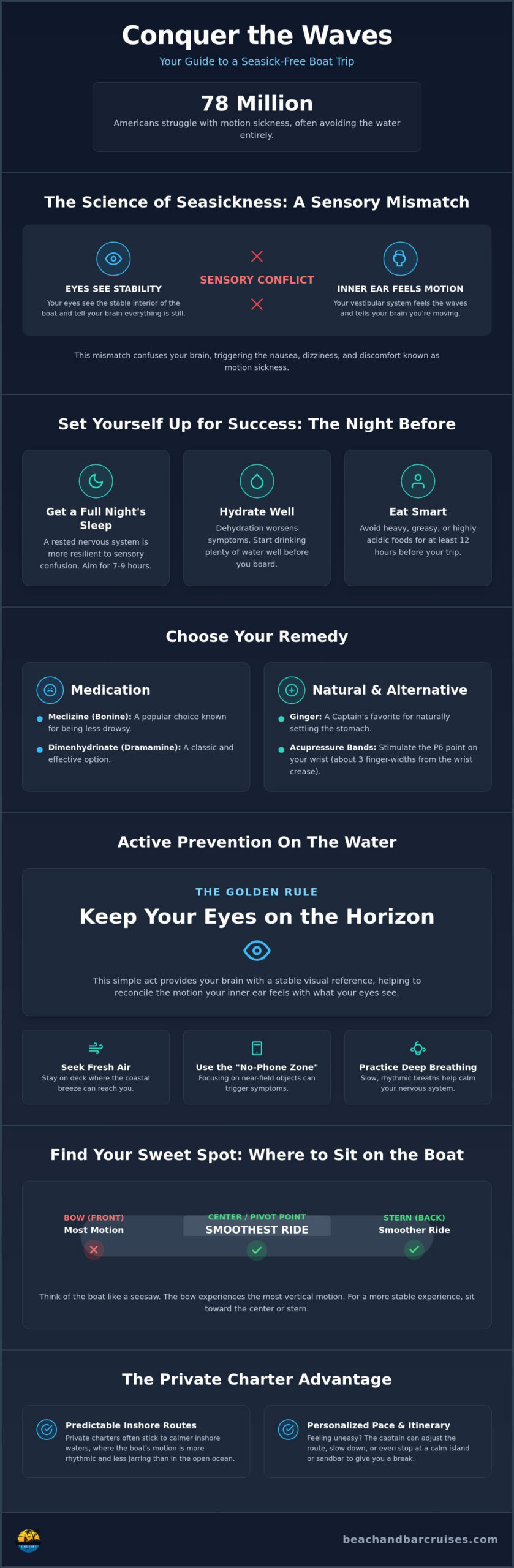
Stepping onto a boat should feel like the start of a grand adventure, not a countdown to discomfort. To truly enjoy your time on the water, it helps to start with the basics of how your body reacts to the sea. Understanding Motion Sickness is about recognizing a sensory conflict where your inner ear feels motion your eyes do not see. Sensory conflict is the primary cause of nausea on the water, occurring when your brain receives clashing signals from your eyes and your vestibular system. While a 21-foot boat offers an intimate connection to the coastal scenery, its motion is immediate. However, in the calm inshore waters we frequent, this movement is often more predictable and rhythmic than the jarring swells of the open ocean.
Common triggers can make these sensations worse. Engine fumes, excessive heat, or focusing on near-field objects like your smartphone can quickly disrupt your balance. Identifying the best time of day for a dolphin cruise helps, as morning trips often provide the smoothest conditions, but your physical preparation is just as vital. To better understand how to prepare for your trip, watch this helpful video:
The Night Before: Setting the Stage for Success
Your journey to a comfortable day on the water starts the evening before. A full night of sleep is critical for keeping your nervous system regulated and resilient. Hydration is your best friend; start sipping water well before you step onto the dock to ensure your body is ready for the sun and salt. Watch what you eat, too. It’s best to avoid heavy, greasy, or highly acidic foods at least 12 hours prior to your departure. For more tips on making the most of your coastal vacation, feel free to explore our collection of local guides.
Medication vs. Natural Remedies
Many guests find success with over-the-counter options. Meclizine, often found in Bonine, is known for being less drowsy, while Dimenhydrinate, the active ingredient in Dramamine, is a classic choice. If you prefer a natural approach, ginger is a Captain’s favorite. This powerful root is excellent for settling stomachs naturally. You might also try acupressure bands. These work by stimulating the P6 point on the wrist. Just make sure they’re positioned correctly, about three finger-widths above the wrist crease, to feel the maximum effect.
Active Prevention Strategies While on the Water
Once you step aboard and the lines are cast off, your focus shifts to active management of your environment. The “Golden Rule” for any passenger is to keep your eyes fixed on the horizon. This simple act provides your brain with a stable visual reference, helping to reconcile the movement your inner ear feels with what your eyes see. Following CDC prevention strategies like these can make a massive difference in your overall comfort throughout the trip.
Fresh air is your next best ally. Staying on deck where the coastal breeze can reach you is non-negotiable if you are prone to sensitivity. Avoid the temptation to check your notifications or scroll through your photos. We call this the “No-Phone Zone” because focusing on near-field objects while the vessel moves is the fastest way to trigger a seasick response. If you start to feel a flutter of anxiety, practice deep, strategic breathing. Slow, rhythmic breaths help calm the vagus nerve and signal to your body that you’re safe and relaxed.
Where to Sit on a Private Charter Boat
Think of the boat like a seesaw. The bow, or front, experiences the most vertical motion as it meets the waves. For the smoothest ride, head toward the “Pivot Point.” Sitting toward the center or the stern provides a much more stable experience because these areas move less than the ends of the vessel. You can learn more about boat terms like the helm and stern to help you find the perfect spot. Choosing the best time of day for a dolphin cruise, such as a glassy morning departure, also ensures the boat stays level and steady from the start.
Engagement and Distraction
Keep your mind busy with the natural beauty of the surrounding coastal environment. Spotting wildlife or identifying local landmarks helps your brain process motion more effectively than sitting still and worrying about how you feel. Active scanning for dolphins helps align the inner ear and eyes by giving you a moving target to track against the distant horizon. Light conversation and a bit of tropical music also prevent the mind from focusing on stomach discomfort. If you’re ready to test these strategies, consider booking a Dolphin & Sightseeing Cruise where we prioritize your comfort at every turn.
The Private Charter Advantage: Tailoring the Trip to Your Comfort
Choosing a private charter means you aren’t just a ticket holder; you’re a guest with a dedicated guide. A USCG-licensed Captain brings years of experience to your excursion, often spotting the early signs of discomfort before you even realize they’re happening. They can adjust the boat’s speed or the angle of the hull to the waves instantly. This level of professional attention is a key part of managing and preventing motion sickness during your time on the water. Plus, the private setting removes the embarrassment factor. In a small group of family or friends, the pressure to “tough it out” disappears, allowing you to relax and enjoy the coastal scenery at your own pace.
Inshore vs. Offshore: Why Water Choice Matters
While large public tours often venture into open water where rolling swells are common, a private charter has the flexibility to stay inshore. These protected waters are significantly calmer and offer a much smoother experience for those with sensitive stomachs. Our modern 21-foot Tidewater vessel is designed specifically for navigating these shallow, tranquil areas, ensuring you get the best views without the heavy pitching of the deep sea. It’s all about embracing the “Ahoy” spirit of a stress-free day. Read more about maritime greetings and culture to get into the coastal mindset before you board.
Customizing Your Itinerary for Sensitive Travelers
The ability to change the plan on the fly is a game-changer for ocean comfort. If a guest starts to feel uneasy, we can pull up to a secluded beach for a bit of island hopping. Stepping onto solid ground for even a few minutes can completely reset your inner ear and refresh your spirit. Many visitors find that the best time of day for a dolphin cruise is during the late afternoon or sunset, as the wind often dies down and the water becomes glassy. Ready for a worry-free day on the water? Explore our private cruise options and let us handle the technical work while you focus on the dolphins and the breeze.
Set Sail with Confidence and Comfort
You’ve unlocked the secrets to staying comfortable on the water, from mastering the “Golden Rule” of the horizon to choosing the best time of day for a dolphin cruise for the glassiest conditions. Small boat travel doesn’t have to be a source of worry when you have the right strategies and a professional guide to lead the way. By focusing on the fresh air and the distant shoreline, you can turn a potentially nervous trip into a relaxing escape that everyone in your group can enjoy.
Leave the technical work to us and focus on making memories with your favorite people. Our USCG Licensed Captain has years of experience navigating these local waters to ensure every guest feels their best. We host private groups of up to 6 people on our modern 21-foot Tidewater boat, which is designed specifically for a smooth and intimate ride through our beautiful inshore areas. You’ll have the space and privacy to relax without the crowds of a public tour.
Don’t let old fears keep you on the dock. Book Your Stress-Free Private Charter with Captain Mike today and experience the joy of the Alabama coast from a whole new perspective. We can’t wait to welcome you aboard for an adventure that prioritizes your relaxation above everything else.
Frequently Asked Questions
Is it better to have an empty or full stomach before boating?
It’s best to have a light, settled stomach before you head out on the water. Being completely empty can actually increase your sensitivity to motion, while a heavy or greasy meal can cause digestive distress. If you’ve booked the best time of day for a dolphin cruise in the morning, try a small breakfast of plain toast or a banana. This provides enough energy to stay regulated without overwhelming your system during the excursion.
How long does it take for seasickness to go away once I am on land?
Most passengers feel a significant sense of relief the moment they step back onto solid ground. For the majority of travelers, the acute symptoms of nausea and dizziness fade within minutes of disembarking. However, some individuals experience a lingering sensation known as “dock walk,” where they feel like they’re still swaying for a few hours after the trip. Staying hydrated and walking on a flat surface helps your inner ear recalibrate quickly.
Can kids get seasick on a small boat more easily than adults?
Children between the ages of 2 and 12 are generally more susceptible to motion sickness than adults. Their inner ears are still developing, which can make the sensory conflict between their eyes and the boat’s motion more pronounced. To help them stay comfortable, encourage them to look at the shoreline or play a game of “spot the dolphin.” Engaging their curiosity keeps their eyes on the horizon and helps their brain process movement effectively.
What is the best time of day for a dolphin cruise to avoid rough water?
The early morning is widely considered the best time of day for a dolphin cruise if you want to avoid rough water. During these early hours, the winds are usually at their calmest, resulting in a glassy and predictable surface. As the day progresses, coastal heating often causes the sea breeze to pick up, which can create a light chop. Booking a morning departure ensures your group enjoys the smoothest possible ride through the inshore bays.
Article by
Captain Les
Captain Les has been operating boats for 40 years. The last 10 years have been in the waters around Orange Beach so he is very familiar with the waters and the area.